Live dashboard demo
This page runs the Pacto dashboard, Pacto's web page, in your browser. Pacto and a set of demo contracts are compiled to WebAssembly, a format browsers run directly. The demo needs no server, and all its data stays in the tab.
Open the live dashboard demo →
The first visit downloads about 4.7 MB (19.3 MB unpacked). On a slow connection give it a moment: the loading strip counts the seconds, and the browser keeps a copy afterwards.
What to look at
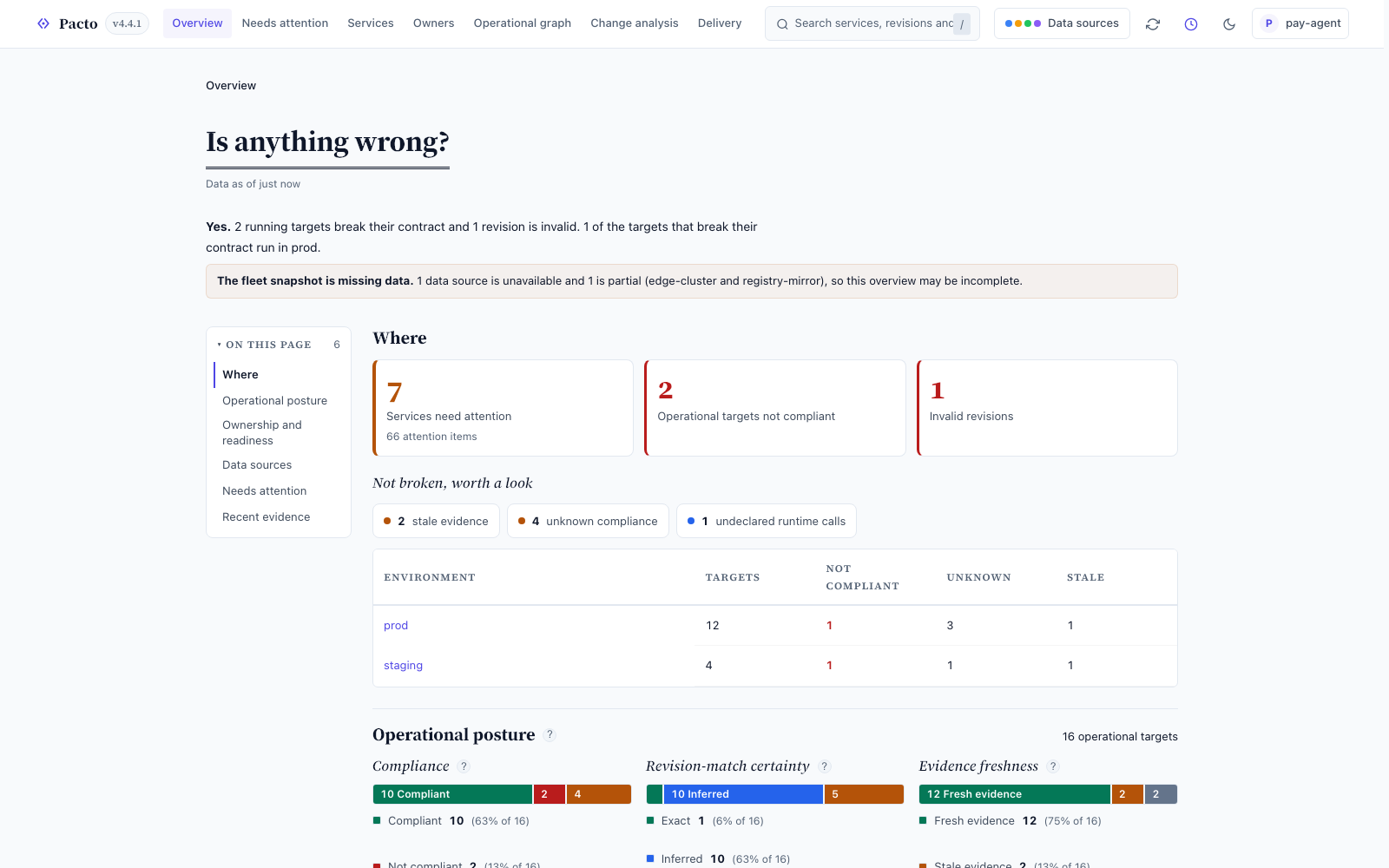
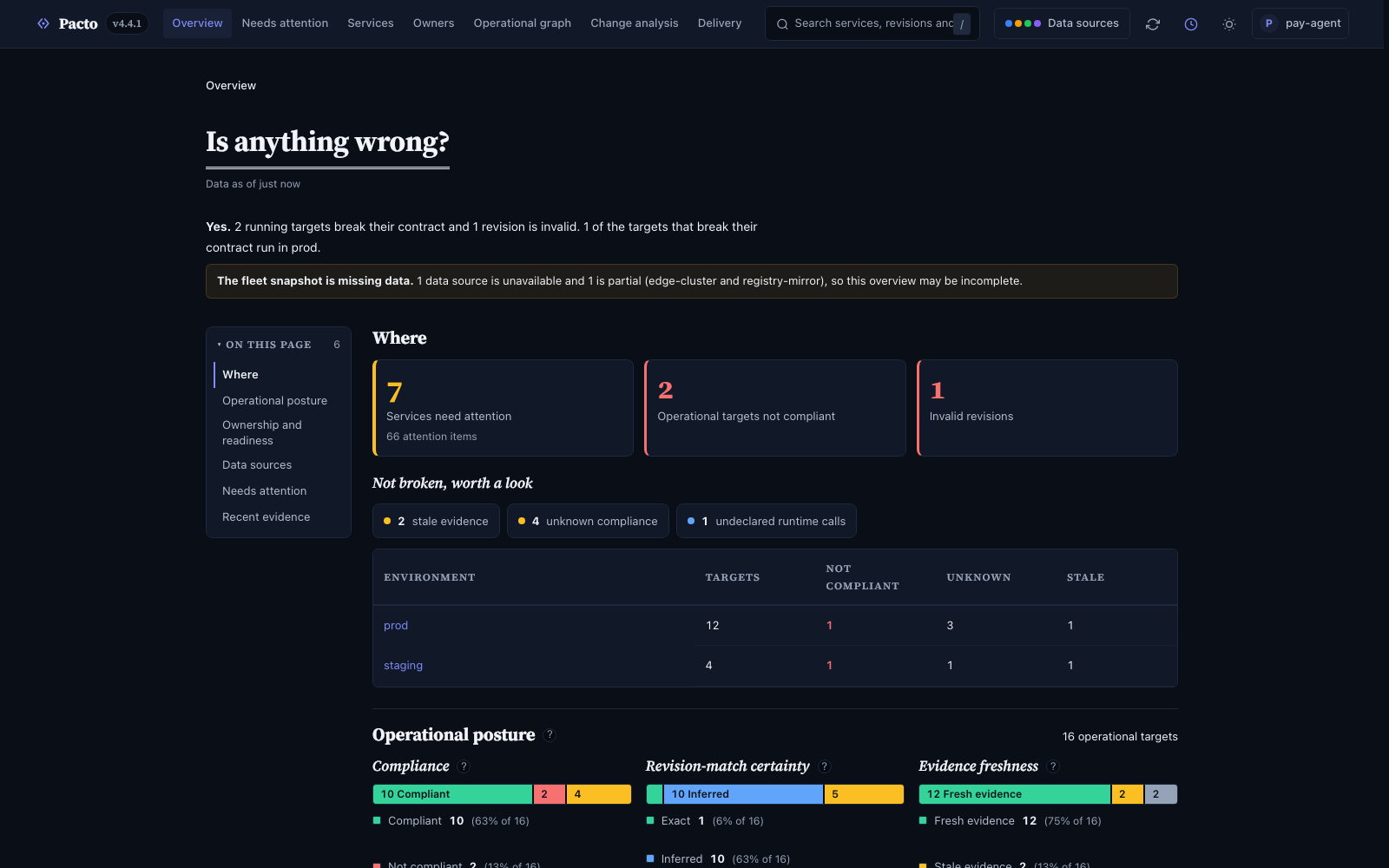
- Fleet overview: thirty-eight made-up services and who calls whom: the thirty-six of the CLI tour plus two from a partner registry, a second domain. The page opens on its answer to Is anything wrong? and says some of the information is missing. Posture, ownership and data sources stay open below it. Pacto always reports what it could not see.
- One service's dependency graph:
payments-servicehas six published versions. The graph shows which services call it and what a change would reach. - Change analysis: the
v1.2.1 → v2.0.1step removes the/chargesAPI and shows which consumers the break reaches. - Promises, schedules and environments:
inventory-serviceretires one interface past its sunset and one before it, and each consumer shows whether it gets the guarantees it requires: met, refused or not verified. Change analysis from 2.1.0 to 3.0.0 lists the consumers it refuses, and the operational graph marks the refused edges.storefront-web1.2.0 checks three environments: one passes, one fails at a line of its values file and one is not verified. The guided tour stops oninventory-servicebefore it hands off to the CLI tour. - Delivery, simulated: press Play the delivery story. First
pacto initgives a plain service a contract. Then a safe change ships on its own, a bad release is rolled back, a breaking change asks only the teams it would break, and every step reads back as a signed record. Last, the tour opens the Autonomy tab and an eval check signed by the runner that ran it (see below). Switch person lets you act as an AI agent (pay-agent), Alice or Carol, to see who may decide what.
The demo includes two oddities on purpose. platform-app-config appears
twice because two different services share that name, and Pacto tells services
apart by more than their name. One
history shows a gap and one record is signed by a key nobody trusts, so you
can see how Pacto reports them.
What the delivery story shows
The delivery screens play the payments story, the scenario every demo shares.
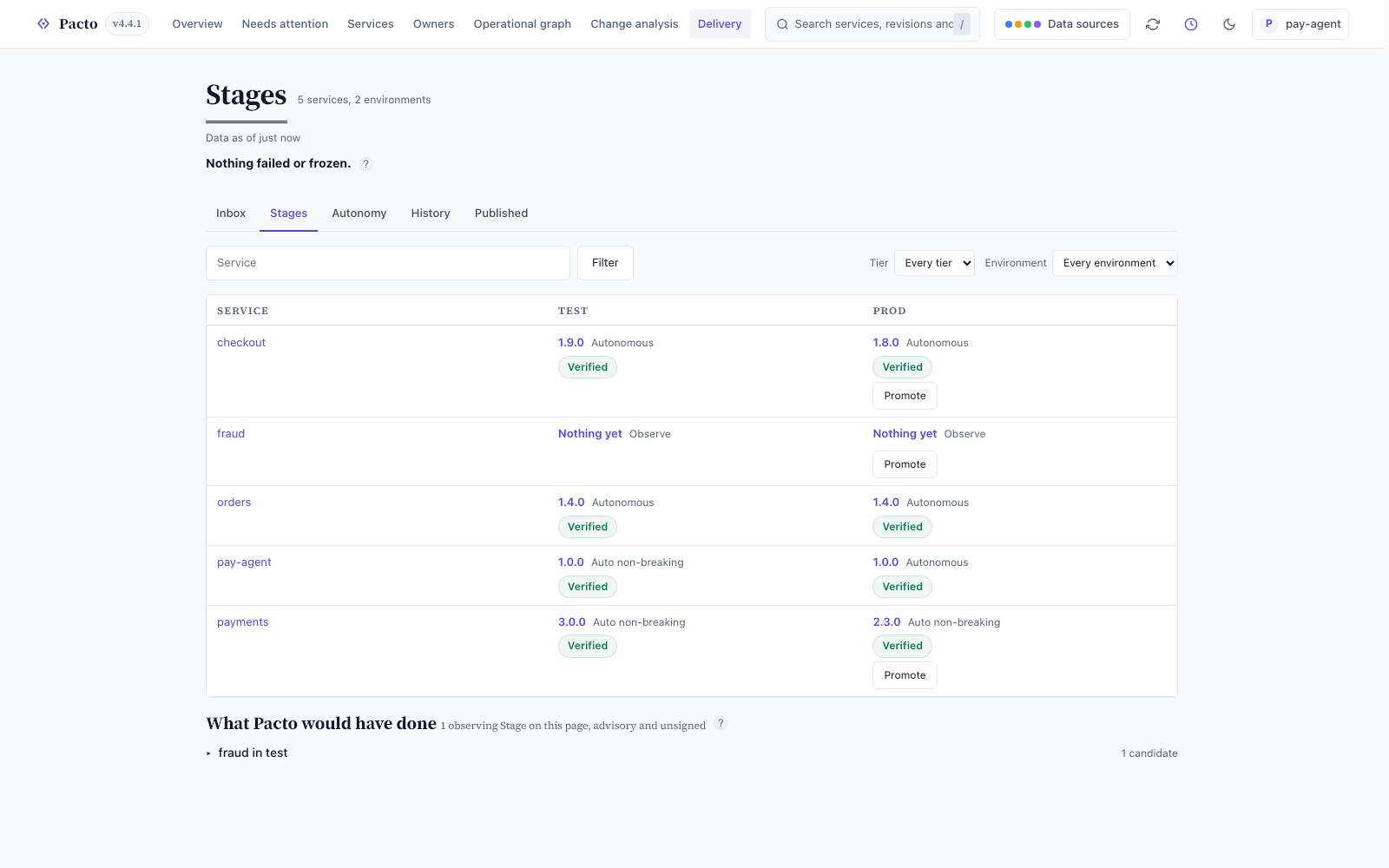
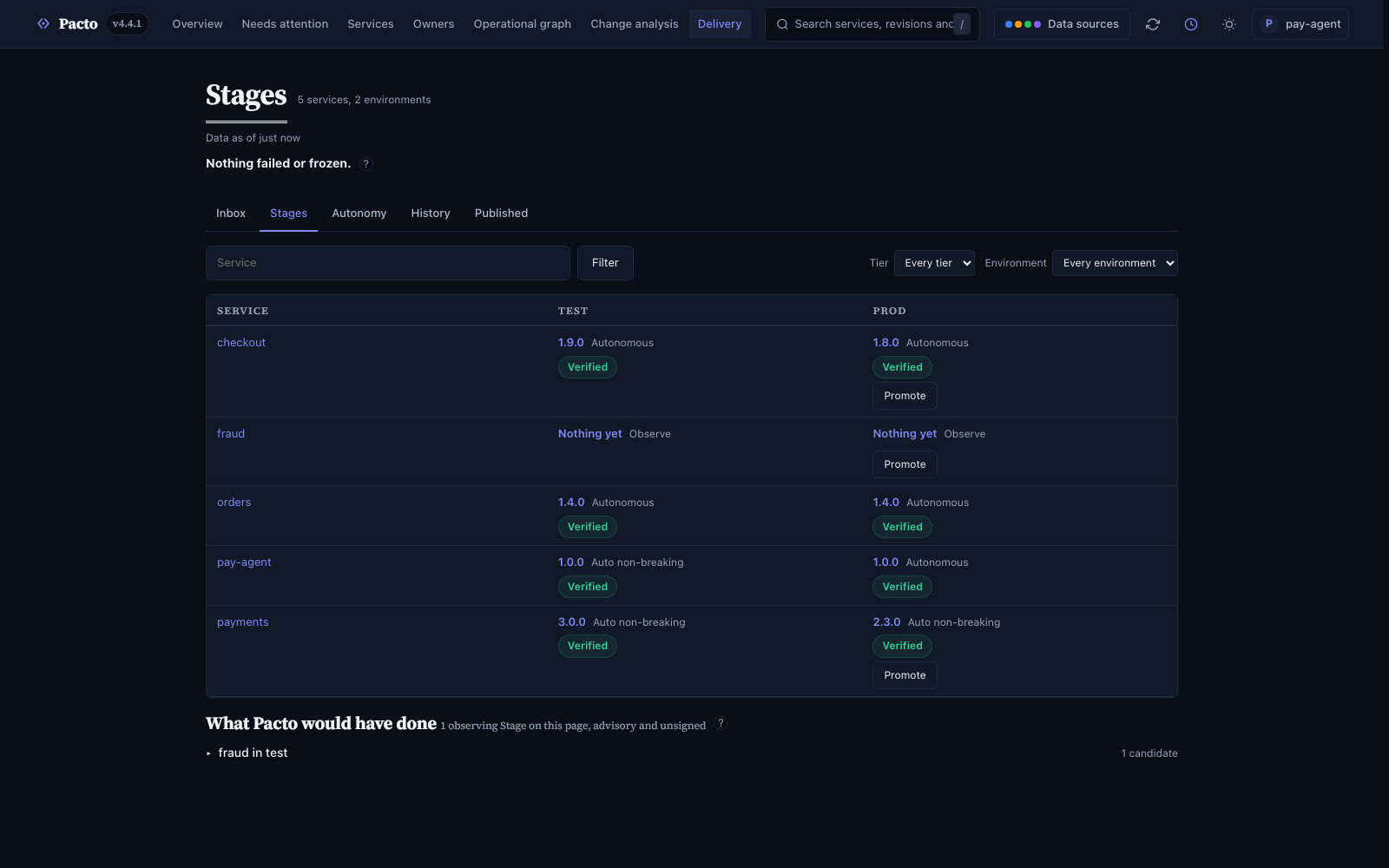
Before the tour starts, the tab has already played its first steps, so the screens show:
- A new service that only watches.
pacto initwrote fraud's contract, and its Stages start on observe, the lowest level of the autonomy ladder. GitOps shipped fraud 1.0.0 to test. Pacto moved nothing and noted it would have shipped it with nobody involved. That one verified version earns a proposal to move test up to advise: the demo sets the Stage to propose after one version, where the default is 10. Propose opens the raise, and only a person on team risk may answer it. Nobody in the demo is on team risk, so it stays a proposal. - A step down after a failure. payments 2.4.0 shipped to prod with nobody involved and failed its health check, so Pacto rolled it back and stepped the Stage down one level, to auto for non-breaking changes. Lowering a level needs no approval. payments in test stepped down the same way when 2.4.2 failed.
- A version that names no prod environment. payments 2.4.1 is the first version to declare environments, and it declares only test. It shipped to test, but its promote to prod waited for team payments, and Alice rejected it. 2.4.2 declares every environment, and its values pass the same check.
- A caller with no contract. ledger-export runs in test with no contract and calls payments. So the breaking payments 3.0.0 waited in test until Alice accepted that unknown, and the Autonomy tab lists the missing contract as one thing that keeps payments in test from autonomous.
- An agent with a signed eval. pay-agent, the AI agent, is a service like any other: its contract ships its eval suite as a check. Its test Stage ran the suite through a runner that signs its count. 1.0.0 passed 2 of 2. 1.1.0 passed 1 of 2, so it rolled back and test stepped down. The Checks on the change page say who ran the suite and signed the result.
Limitations
The checks on running services and the delivery screens use recorded data, and every delivery screen says "simulated". The plans, checks and history do come from Pacto's own code. Records are signed with a key made in your tab, so nothing outside it can check them, and a reload starts over. The eval runner is a stand-in in the tab whose key anyone can derive, so its signature proves nothing outside the demo. On the Autonomy tab, the share of services with a contract counts only the fleet demo's services.
To run Pacto for real, the Docker Compose demo runs the same dashboard on your machine and the Kubernetes demo runs delivery on a local cluster. The guided tour shows the same facts from the command line, and the Quickstart has you write a contract of your own. To run the dashboard against your own services, see Dashboard container.