Impact analysis (pacto impact)
Impact analysis answers the question a reviewer asks before merging: if this revision ships, who is affected? Give it the old and new contract and it lists the services that depend on this one, whether each still works with the new version, where they run and who owns them.
It joins two things Pacto already has. The semantic diff says how the contract changed (change classification). The operational graph says who depends on the service and where it runs. The CLI command, the MCP tool and the dashboard's Change analysis workspace run the same analysis and, given the same snapshot, return the same answer.
Diff × graph → impact
flowchart LR
    OLD["Old revision<br/>contract + files"] --> DIFF["Semantic diff"]
    NEW["New revision<br/>contract + files"] --> DIFF
    DIFF --> CLASS["Classification<br/>NON_BREAKING · POTENTIAL_BREAKING · BREAKING<br/>breaking and potentially-breaking, kept separate"]

    SNAP["Operational graph<br/>immutable read model"] --> GRAPH["Dependents traversal<br/>direct + transitive"]

    CLASS --> IMPACT["Impact result"]
    GRAPH --> IMPACT
    IMPACT --> CONS["Affected consumers<br/>compatibility verdict · confidence"]
    IMPACT --> TARGETS["Active targets<br/>where the change lands"]
    IMPACT --> OWNERS["Owners to notify"]
A change can break consumers while every spec stays identical, such as an
amount switching from cents to euros. Raise the interface's
compatibilityEpoch and
the diff classifies the revision BREAKING, so its consumers are listed.
The diff is computed once over the old→new revision. The changed service is then looked up in the graph and traversed in the dependents direction, direct and transitive. Each dependent becomes an affected consumer, annotated with the evidence Pacto has for that edge, and the result rolls up the active targets the change would land in and the owners to notify.
Every answer inherits the snapshot's asOf time, completeness and
limitations, so a partial fleet always reads as partial. When no fleet source
holds the changed service, pacto impact adds the new revision to the snapshot
so the services that depend on it are found, and the answer carries
newRevisionAdded: true. A snapshot it cannot add to, such as the dashboard's
published snapshot, answers with a SERVICE_NOT_IN_FLEET limitation, no
consumer list and an unverified gate.
What an affected consumer carries
For each dependent the analysis records:
| Field | Meaning |
|---|---|
| service / domain / owner | Who is affected and who owns them. |
| depth / direct / path | depth is the shortest distance from the consumer to the changed service: 1 is a direct dependent and >1 is transitive. A consumer that depends on the changed service directly is direct even when it also reaches it through another dependent. path is a shortest dependency chain from the consumer to the changed service. |
| required | Whether the consumer declared this dependency as required. |
| compatibility | The consumer's declared compatibility range against the changed service. |
| compatibilityVerdict | Whether the new version satisfies that range. compatible and incompatible both need a declared range and a range and version semver can parse; without all three the verdict is unknown, because an unreadable or absent range is uncertainty. |
| provenance | Where the edge came from: declared, observed, declared+observed or inferred. |
| confidence | How strongly the evidence supports the claim (see below). |
| status / targets | The consumer's aggregate status and the operational targets it runs in. |
| unmet | Each guarantee the consumer requires that the new version does not meet, with both values. |
| note | A plain-words qualifier. On a BREAKING change a compatible verdict only means the range accepts the new version, so the note says to check that the consumer does not use what the change removes. An open range such as >=1.0.0 accepts every new major version, and the note says so. |
Confidence model
Confidence grades how strongly the available evidence supports each affected-consumer claim.
| Confidence | Exact meaning |
|---|---|
| contractual | A declared dependency with a usable compatibility range. The consumer's own contract says it depends on this service and pins the versions it accepts. |
| declared | A declared dependency without a usable compatibility range. The dependency is stated, but no version constraint was pinned, so Pacto cannot compute a compatibility verdict. |
| observed | Runtime use of the dependency was observed in a window. Requires --include-observed. |
| corroborated | The declared dependency and an observed one agree. This is the strongest grade: contract and runtime say the same thing. |
| inferred | A transitive effect reached through another affected service (depth > 1). It follows from the graph. |
| unknown | A direct edge with no declaration and no observation. The effect is possible but unverified. |
An inferred path is a lead to verify. Pacto reaches a transitive consumer through the graph. It tells you where to look; confirm whether the consumer breaks before you act on it.
Observed evidence only raises confidence when you opt in. Without
--include-observedthe analysis is declared-only. Runtime observations then let a direct edge becomeobservedorcorroborated.
A partial snapshot is incomplete knowledge, an unknown verdict is
uncertainty and an inferred consumer is a lead to verify.
Observed edges come from OpenTelemetry traces via --traces <file>. Beyond
corroborating declared consumers, traces surface observed-only (shadow)
consumers: services seen calling the changed service without declaring the
dependency. With traces they appear as direct consumers at observed confidence.
CLI
<old> and <new> are the two revisions to compare: bundle paths or refs. They
are separate from the fleet snapshot and may be oci:// references either way.
pacto impact reads the fleet through the same
source flags pacto fleet does, --local
included, which defaults to .. Point it only at offline sources and the whole
analysis stays offline.
Turn on runtime corroboration with --include-observed, or supply an OTLP/JSON
trace export with --traces, which implies it:
pacto impact ./payments-api@1.4.0 ./payments-api@2.0.0 \
  --local ./services \
  --traces ./traces.json
The output reports the classification, then the breaking and potentially-breaking
changes in separate lists, so a potential break never counts as a confirmed one.
It then lists each affected consumer with its owner, verdict and confidence, the
active targets and a warning when the snapshot is partial. The JSON output also
carries owners and completeness as fields.
Pacto finds consumers only in the sources you pass. With --local alone it
sees only the contracts in those folders. A BREAKING change that none of them
depends on ends clear and exits 0, so No affected consumers. covers only
those folders.
Release gate and exit status
Every answer ends in a release gate, gate, with the reason in gateReason.
The CLI exits on it, and the MCP tool returns it:
gate |
Exit | When |
|---|---|---|
blocked |
1 |
The change is BREAKING and reaches a consumer that does not accept the new version, or has an unmet guarantee, and is active. |
unverified |
2 |
The change is BREAKING and nothing is shown to block it, but the answer cannot clear it: the answer is partial, or consumers depend on the service and none is shown to be safe. |
clear |
0 |
The change is not BREAKING, or the snapshot is complete and no service depends on the changed one. |
A command that could not run also exits 1, with nothing on stdout.
Active means the snapshot knows of somewhere that consumer is deployed: at least one operational target. Compatibility is a statement about contracts; active is a statement about the world.
unverified exists because a breaking change with consumers is never safe by
default. A consumer can be incompatible on paper with no known target, declare
no range, or match only by range. --local bundles declare no targets, so a
declared-only run of a breaking change with consumers exits 2:
$ pacto impact ./api-v1 ./api-v2 --local ./fleet
Impact: api 1.0.0 -> 2.0.0
Classification: BREAKING
Breaking changes: 2
Potentially breaking changes: 0
Affected consumers (1):
  web                          direct     confidence=contractual  compat=incompatible owner=frontend
Release gate: unverified
unverified: the change is BREAKING and 1 consumer depends on api, but none is shown to be both incompatible and running. Review each consumer, and add a source that knows where services run (for example --target-state) to tell deployed impact apart
$ echo $?
2
Give the snapshot a source that knows where things run and the same command blocks:
$ pacto impact ./api-v1 ./api-v2 --local ./fleet --target-state ./targets.yaml
Impact: api 1.0.0 -> 2.0.0
Classification: BREAKING
Breaking changes: 2
Potentially breaking changes: 0
Affected consumers (1):
  web                          direct     confidence=contractual  compat=incompatible owner=frontend
Active targets (1): [production/kubernetes-workload/shop%2Fweb]
Release gate: blocked
breaking changes affect active consumers, which run on known targets and do not accept api 2.0.0: web
$ echo $?
1
Gating in CI
In CI that is one of two deliberate choices. Fail on any non-zero exit and an
unverified breaking change stops the job as a blocked one does. A promotion
pipeline that gates on deployed impact alone can treat 2 as a pass, as long
as the job supplies targets. Gate on the JSON instead (--output-format json,
then classification == "BREAKING") and you gate on the contract alone, which
is what you want before anything is deployed. That JSON carries
schemaVersion: pacto.dev/impact/v1, the compatibility contract to branch on
before reading any other field.
Put it in your repository has a
pull-request step that gates on the JSON. The file --target-state expects is
documented under
target-state fixtures.
The MCP tool and the dashboard
Agents get the same analysis as the read-only pacto_impact MCP tool. It belongs
to the fleet query
family and shares
that family's boundaries: it projects the operational graph. It is read-only and grants no permission.
It is the one fleet tool that rebuilds the graph on every call; the others serve
a frozen snapshot. Its asOf
therefore advances, while the pacto_fleet_* tools' stays at the value they were
started with. When the two disagree they describe the same system at two moments.
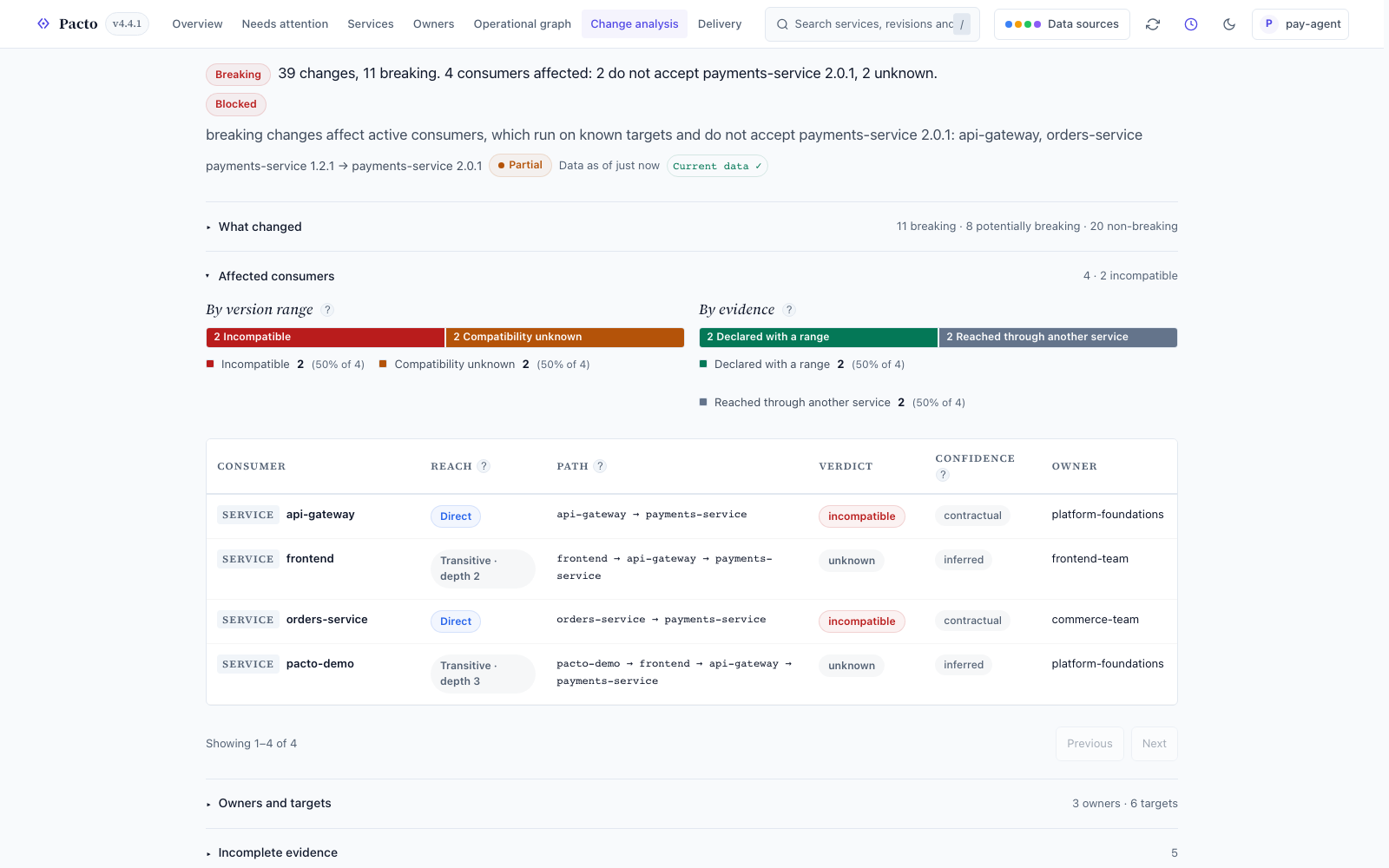
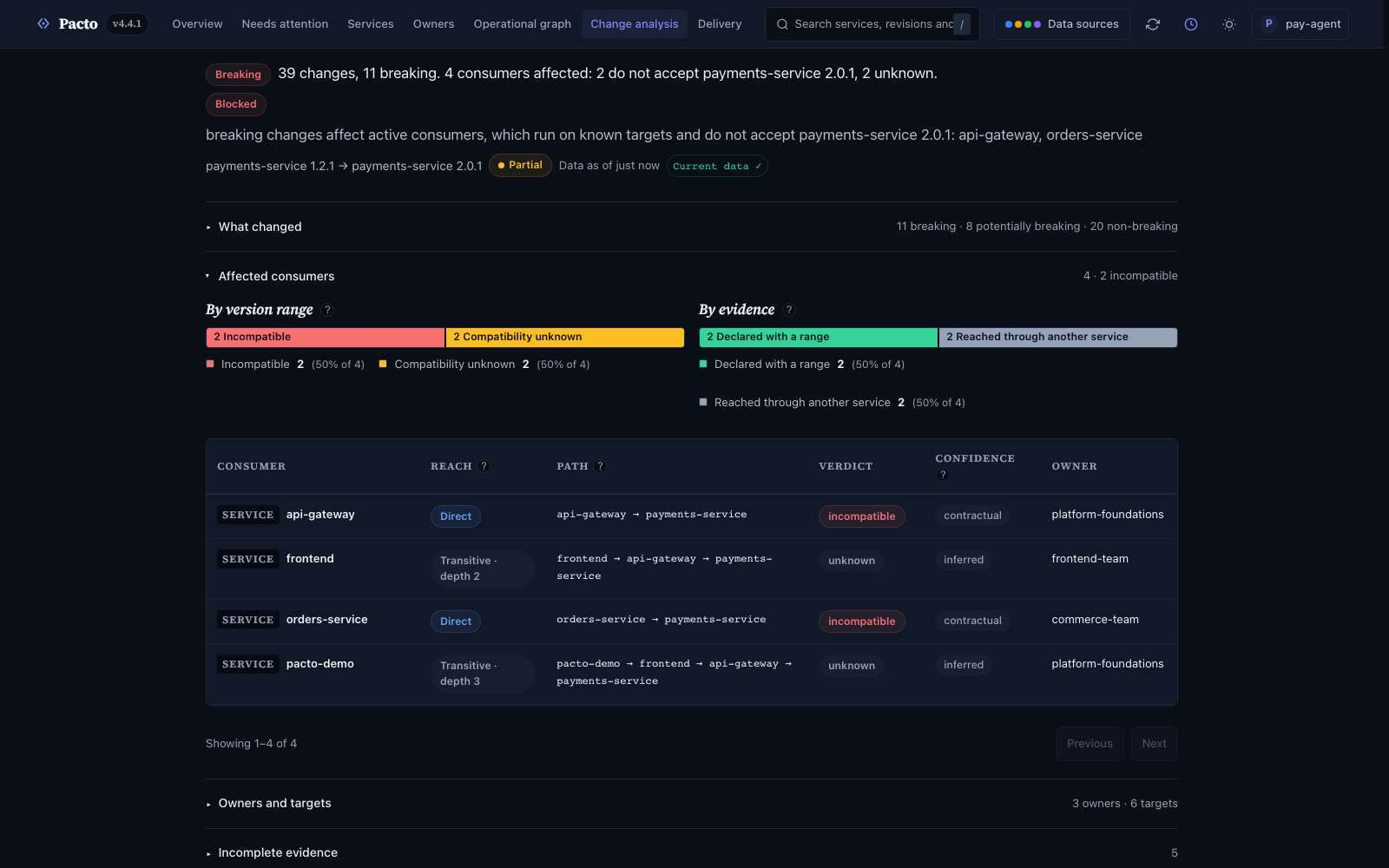
In the dashboard the analysis is one half of the Change analysis workspace,
served by /api/fleet/impact. It is entered from the service or revision you are
already looking at, and the analyzed pair is in the URL so the answer is
shareable. It opens on a one-line answer: what kind of change it is and who it
reaches. What changed, the affected consumers, owners and targets and the
evidence gaps are folded below it, each with its count. It reads the currently published snapshot, the same one the
Operational Graph shows, so its snapshotId matches the graph. The include-observed control is enabled only when the host
declares an observation source, because observed evidence needs a real source.
What's next
- The Pacto Operational Graph: the read model impact projects onto, and the knowledge vocabulary every answer carries
- Change classification rules: the semantic diff impact composes with the graph
- MCP integration: the fleet query tool family
pacto_impactbelongs to